Insert
Insert optimizable latent states at a selected intermediate Transformer layer.
NLCo Lab, BIGAI · BUPT · PKU
01 · Overview
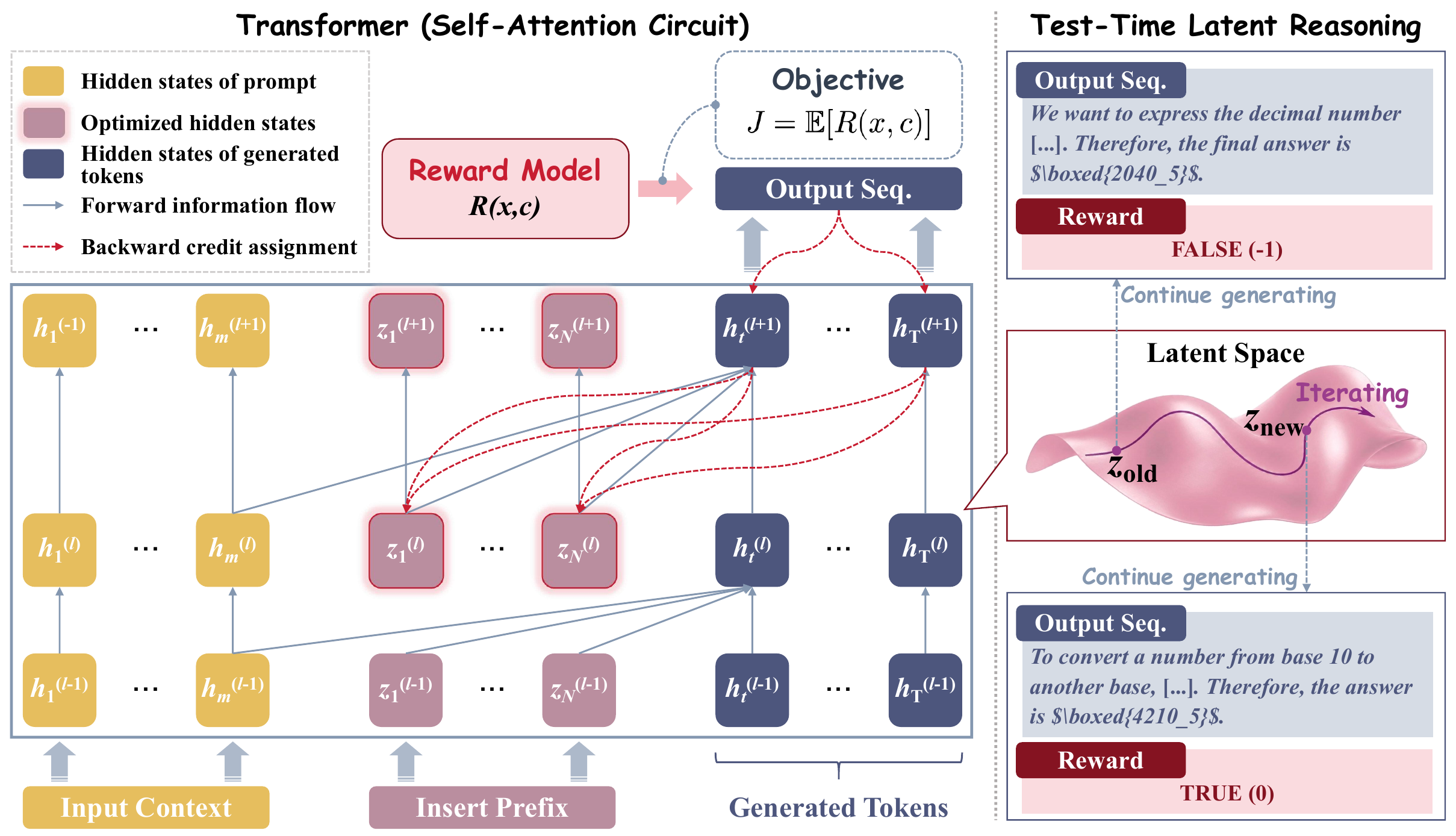
Existing test-time latent reasoning methods use decoded tokens as the interface between latent variables and the reasoning path. This decoding bottleneck makes optimization signals indirect and entangled with intermediate token representations.
GradCuit inserts a small set of optimizable latent states at an intermediate Transformer layer. Self-attention serves as both the forward pathway for token–latent interaction and the backward pathway for reward-weighted credit assignment, supporting direct optimization and inspection of latent dynamics while the base model remains frozen.
Insert optimizable latent states at a selected intermediate Transformer layer.
Propagate reward-weighted gradients from every generated token to every latent state.
Iteratively refine the instance-specific latents while keeping the base model frozen.
02 · Core results
Five instruction-tuned backbones · GPQA-Diamond, GSM8K, and MATH-500 · Boxed and JSON formats
average accuracy across all 30 evaluation settings
points over chain-of-thought prompting
points over the strongest competing method
settings with the best individual result
GradCuit improves over LatentSeek in every benchmark–format aggregate. Under Boxed/JSON, the gains are 2.2/2.0 points on GPQA-Diamond, 2.5/3.8 on GSM8K, and 2.8/8.9 on MATH-500, supporting the benefit of aggregating continuation-token gradients through the remaining Transformer computation.
All backbones · Avg. · Accuracy (%)
Each benchmark–format group uses its own relative range: 90% of that group’s lowest score to 110% of its highest score, capped at 100%. Exact scores remain labeled for direct reading.
03 · Reasoning cases
Question
The solution must satisfy both t(t + 2) ≡ 1 (mod 23) and the odd-integer constraint.
We are given that $t+2$ is the inverse of $t$ modulo $23$. [...] $t$ modulo $23$ is $\boxed{20}$.
We are given that $t+2$ is the inverse of $t$ modulo $23$. [...] The answer is $t = \boxed{17}$.
GradCuit directly updates hidden states without explicitly modifying the token sequence, correcting the answer from 20 to 17 without introducing malformed text.
04 · Robustness & interpretability
We analyze sensitivity to learning-rate selection, dependence on reward guidance, and token-level gradients from continuation tokens to optimized latent states.
Robustness to learning rates
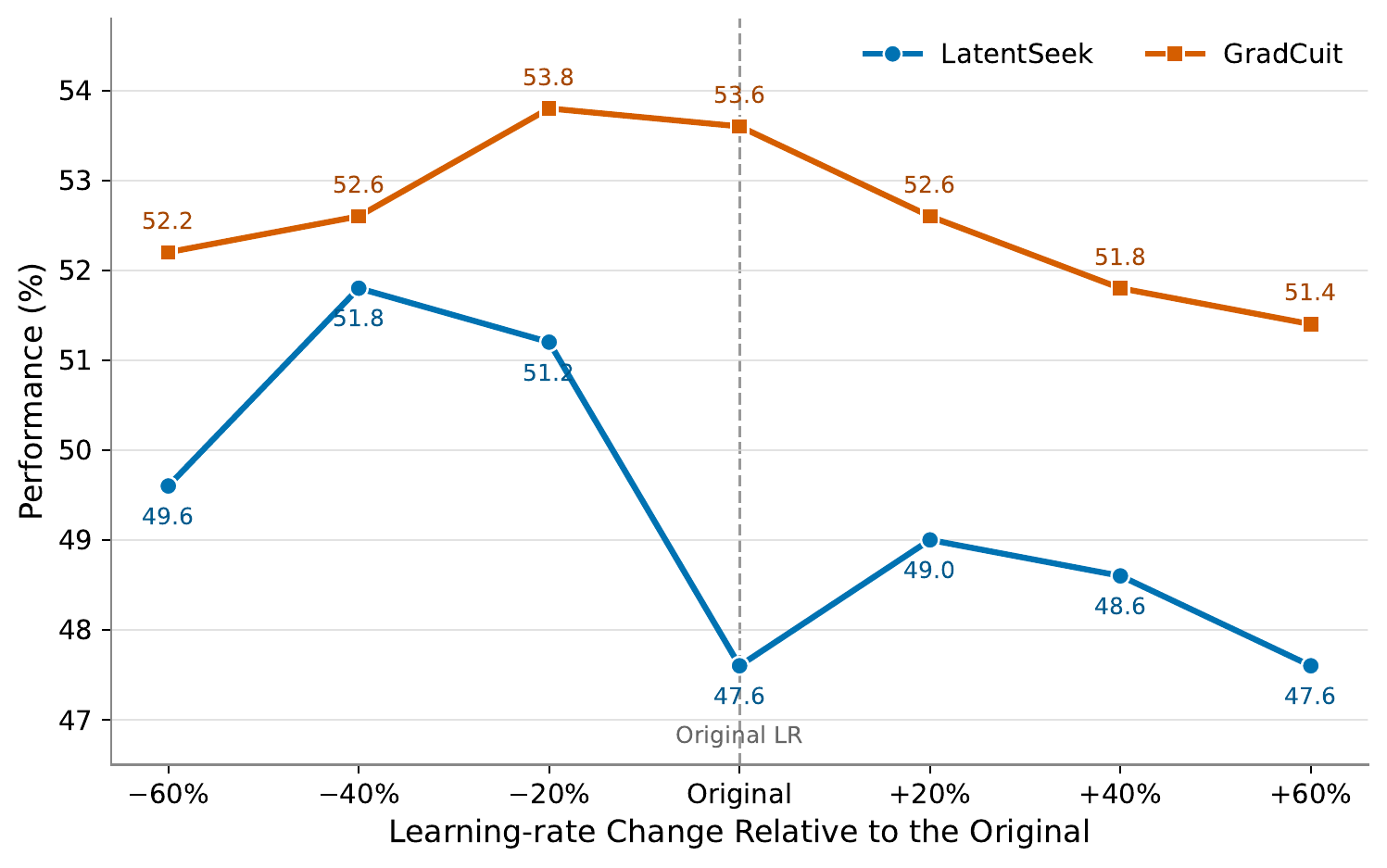
Across seven learning-rate settings, GradCuit varies only from 51.4–53.8%, compared with 47.6–51.8% for LatentSeek. Its average is 52.6% versus 49.3%, and its standard deviation is 0.82 versus 1.53.
Robustness to update directions
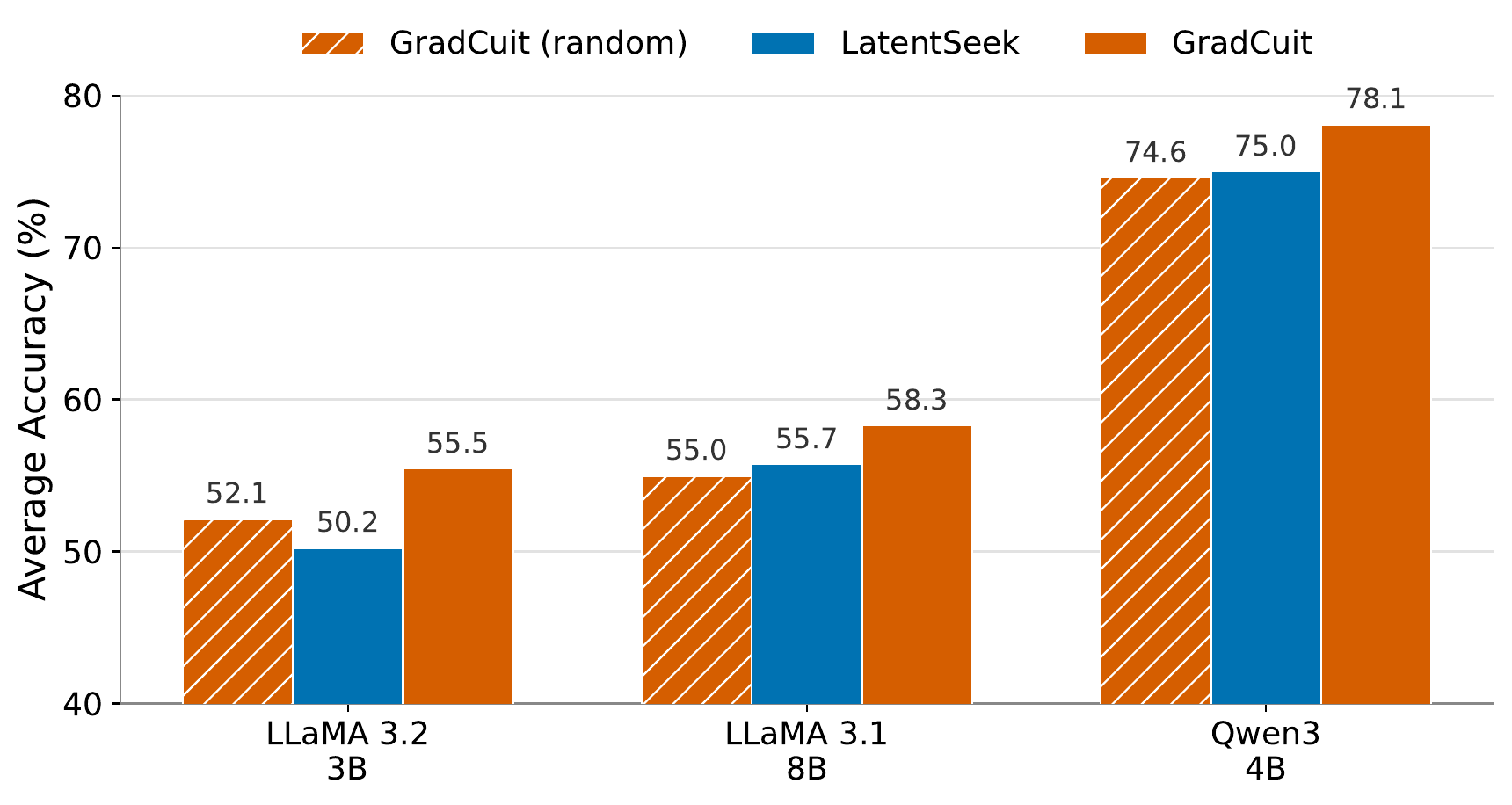
Replacing reward-derived gradients with Gaussian random directions yields 60.6%, slightly above reward-guided LatentSeek at 60.3%. Direct latent interaction makes the selected-layer optimization space more accessible and robust, while reward guidance determines how effectively it is explored.
Token-level attribution
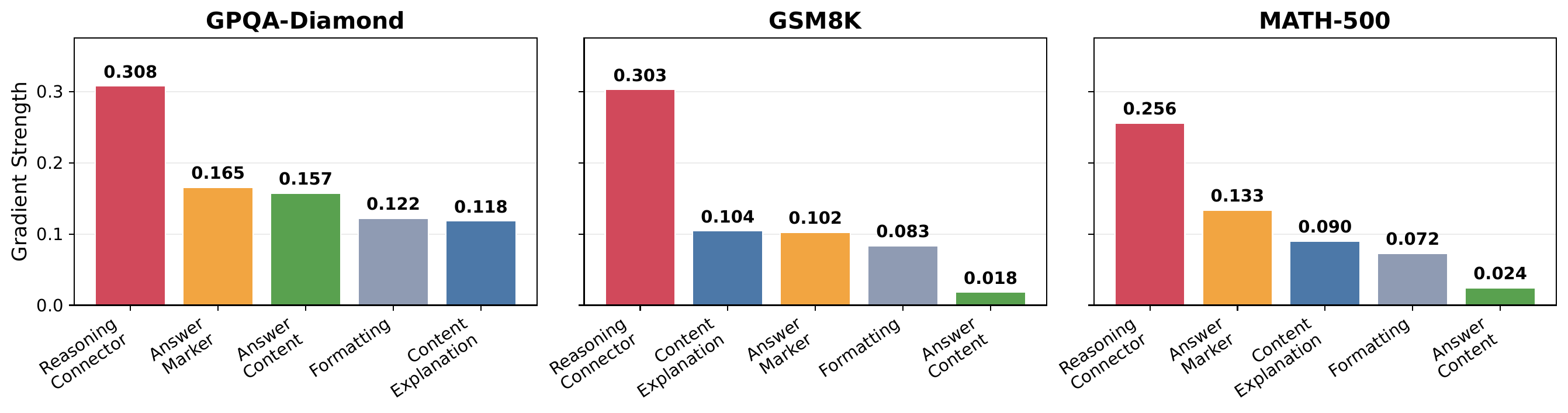
Across all three benchmarks, tokens such as because, therefore, and then show the highest first-order sensitivity. The optimized latent states primarily influence how the model connects and advances successive reasoning steps, rather than affecting all continuation tokens uniformly.
Optimized-layer analysis
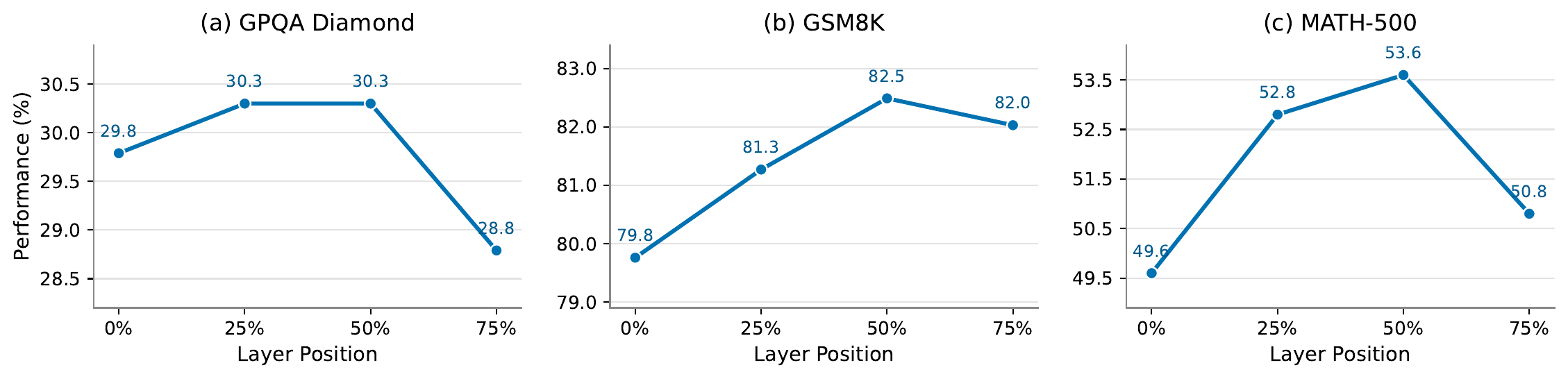
The optimal layer is task-dependent, but the strongest results consistently occur between 25% and 50% of network depth. At these depths, hidden states are contextualized enough to provide informative signals while retaining sufficient downstream computation to propagate and refine the optimized latent.
05 · Contributions
GradCuit inserts a small set of learnable latent states at an intermediate Transformer layer, enabling self-attention to provide a direct pathway for forward token–latent interaction and backward credit assignment.
By propagating reward-weighted gradients directly from generated tokens to the latent states, GradCuit achieves greater optimization robustness than previous latent-reasoning methods.
GradCuit improves accuracy over CoT by 6.6 points and the strongest enhanced reasoning baseline by 2.4 points on average; its gradient pathway also reveals the important role of reasoning-connector tokens.
06 · Conclusion
Together, these findings demonstrate that GradCuit enables more robust and interpretable test-time latent reasoning.
GradCuit inserts optimizable latent states at a selected Transformer layer, making every continuation-token log-probability differentiable with respect to every latent state and enabling direct reward-weighted optimization while keeping the base model frozen. Across five backbones and three benchmarks, it achieves the highest average accuracy among all evaluated methods and substantially lowers sensitivity to learning-rate selection.
Token-level gradient attribution shows that latent influence concentrates on reasoning-connector tokens, while ablations establish the complementary roles of the inserted prefix, latent-state optimization, and reward guidance. Early-to-middle Transformer layers are the most effective optimization space; representative cases show that direct hidden-state updates can correct erroneous answers without introducing malformed text.
Reference
If GradCuit supports your research, please use the official arXiv citation.
arXiv:2608.02585@misc{yu2026gradcuitcreditassignedgradientflow,
title={GradCuit: Credit-Assigned Gradient Flow Enables Robust and Interpretable Test-Time Latent Reasoning},
author={Zhaoxin Yu and Qi Shen and Hengli Li and Zhaowei Zhang and Song-Chun Zhu and Chi Zhang and Zilong Zheng},
year={2026},
eprint={2608.02585},
archivePrefix={arXiv},
primaryClass={cs.LG},
url={https://arxiv.org/abs/2608.02585},
}